Simulating Human Behavior: AI Agents Mirror Real People with 85% Accuracy
Stanford researcher Joon Park (@joon_s_pk) and his team have made a breakthrough in AI research, leveraging language models to build generative agents that simulate human behavior with remarkable accuracy.
Their research paper “Generative Agent Simulations of 1,000 People” introduces a novel agent architecture that successfully simulates the attitudes and behaviors of over 1,000 real individuals, potentially paving the way for a new kind of tool to study human behavior.
Key Findings
Technical Implementation
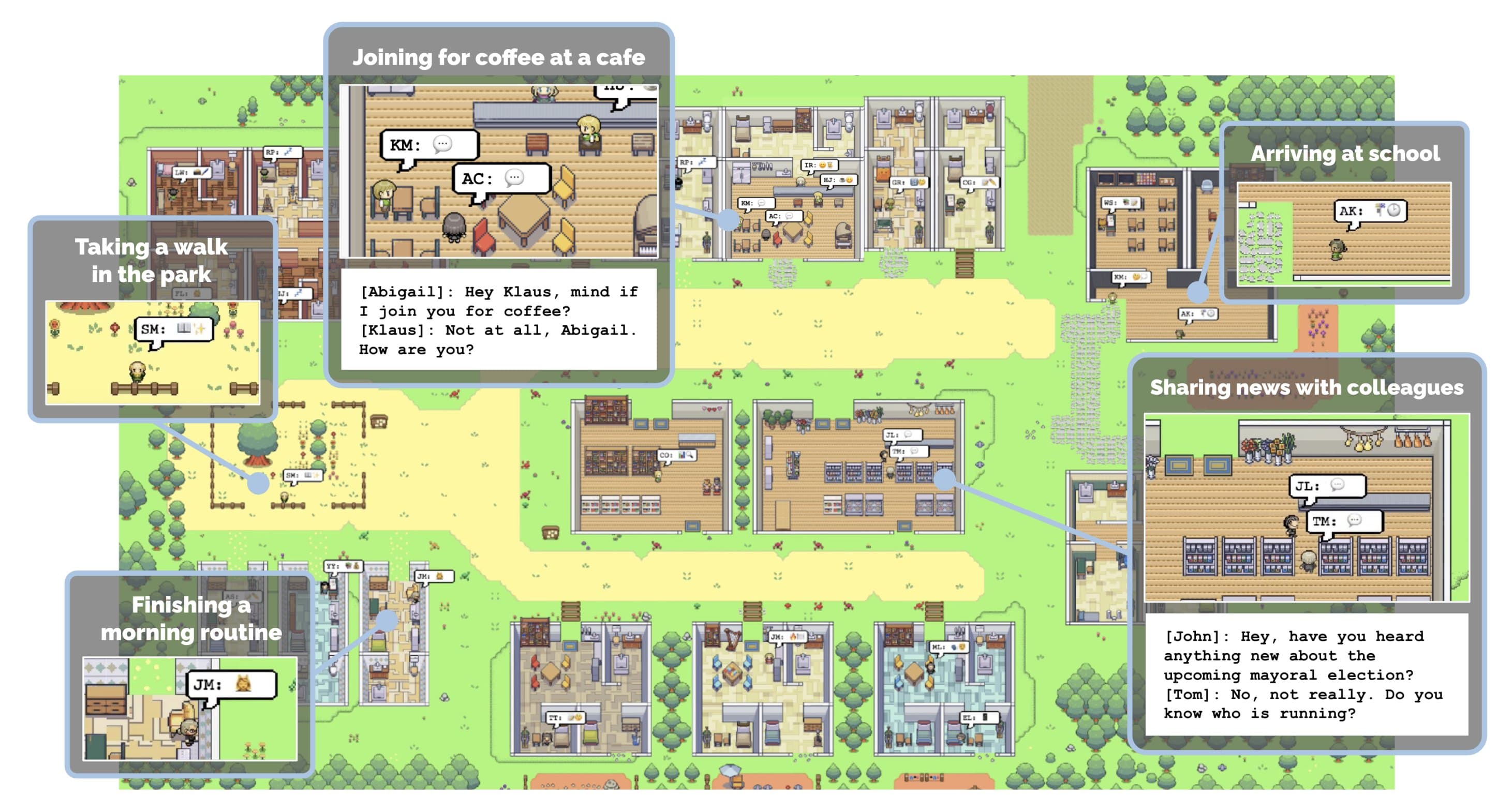
The simulation environment showcased in this research uses a top-down 2D approach similar to virtual office platforms like SkyOffice. The environment was built to simulate various daily scenarios where AI agents interact, from casual coffee meetings to workplace conversations.
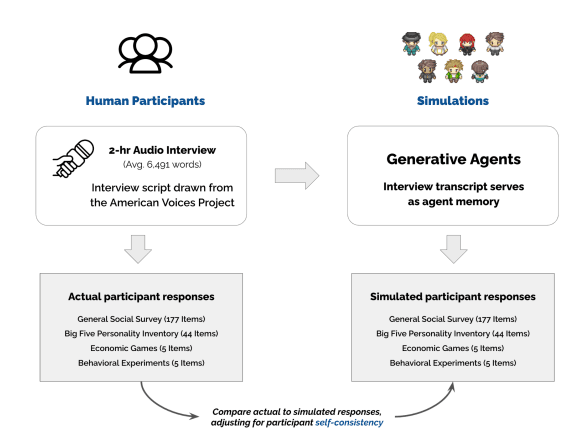
Research methodology showing the flow from 2-hour audio interviews with human participants to generative agents, and the comparison of responses across various tests including the General Social Survey, Big Five Personality Inventory, and Economic Games.
Access and Privacy
The research team has implemented a two-pronged access system to balance research accessibility with participant privacy:
While the participant data remains private, the team has released an open-source implementation along with a sample generative agent for developers to experiment with. The system includes built-in safeguards for usage audits and withdrawal options to respect individual consent and agency.
Business Implications
This groundbreaking research demonstrates the immense potential of AI agents to understand and replicate human behavior with remarkable accuracy. For businesses, this opens up unprecedented opportunities to enhance operations, customer experiences, and decision-making processes through behavioral simulation and testing.
At ITERIA, we see this research as a significant step forward in the field of AI agents. The ability to create agents that can accurately model human behavior has profound implications for how businesses can approach automation, optimization, and decision-making in the future.
Reference: Park, J. S., Zou, C. Q., Shaw, A., Hill, B. M., Cai, C., Morris, M. R., Willer, R., Liang, P., & Bernstein, M. S. (2023). Generative Agent Simulations of 1,000 People. arXiv:2411.10109