Agents Are Not Enough: Building the AI Workforce of Tomorrow

In the midst of growing AI integration across industries, autonomous agents are experiencing a dramatic resurgence. But as new research from the University of Washington and Microsoft Research reveals, simply making agents more capable won't be enough. The path to effective AI systems requires a more comprehensive approach.
A recent paper from researchers at University of Washington and Microsoft Research (Agents Are Not Enough) helps cut through the noise, offering crucial insights for organizations looking to build sustainable AI systems.
What Do We Mean By “Agents”?
The definition of AI agents has evolved significantly - from early symbolic AI systems of the 1950s through today's complex autonomous systems. As the research notes, modern AI agents range from simple task automation to sophisticated decision-making systems that can:
The Current State of AI Agents
The Evolution of Agent Architectures
Early attempts at building agent systems through cognitive architectures like SOAR and ACT-R aimed to model human cognition by integrating perception, memory, and reasoning. While sophisticated, these systems struggled with scalability and real-time performance. Today's approaches focus less on mimicking human cognition and more on creating practical, specialized agents within a broader ecosystem.
Today's AI agents demonstrate remarkable capabilities within specific domains. Successful deployments are emerging across:
Yet both research and practical experience reveal persistent challenges:
Why Agents Alone Aren't the Answer
The research makes a compelling argument that simply developing more capable agents isn't sufficient. Success in AI transformation requires:
The Ecosystem Approach
The researchers propose an innovative three-part ecosystem:
Specialized task executors focused on specific functions and capabilities
These are sophisticated user representations that go beyond simple profiles or personas. Sims capture multiple aspects of user preferences, behaviors, and contexts, allowing for more nuanced and personalized agent interactions. Different Sims can have varying privacy and personalization settings, enabling appropriate agent interactions across different contexts.
Coordination and interaction layers that manage communication between users, Sims, and Agents
This framework aligns with our approach at ITERIA, where we deploy specialized agents within a managed ecosystem.
Practical Implementation Strategies
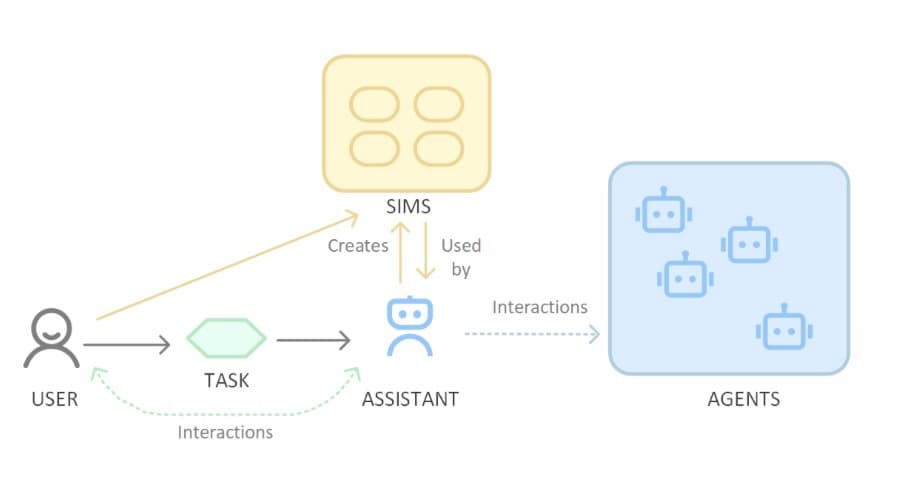
Envisioning a new eco-system with Agents, Sims, and Assistants.
Successful agent deployment requires a structured approach:
Start with Analysis
Build in Stages
Maintain Human Oversight
Emerging Patterns & Best Practices
The UI-First Pattern
Rather than thinking of agents as fully autonomous actors, many successful implementations use them as an intelligent UI layer. This “LLM as UI” pattern, with domain experts in the loop, offers several advantages:
The Macro Builder Pattern
Another emerging pattern uses agents to build deterministic workflows:
Avoiding the Hype Trap
Successful implementations focus on:
The Path Forward
As Jensen Huang noted, “The IT department of every company is going to be the HR department of AI agents in the future.” This transformation is already underway, but success requires more than just deploying agents - it needs a comprehensive ecosystem approach that balances automation with human oversight.
Ready to Build Your AI Workforce?
At ITERIA, we're not just deploying agents - we're building the future of work. Our approach combines cutting-edge research with practical business implementation to deliver measurable results.
References:
University of Washington and Microsoft Research. (2023). Agents Are Not Enough. arXiv:2412.16241
Note: As one developer noted in recent technical discussions, “agents are the 2020s version of data science in the 2010s” - a parallel that highlights both the transformative potential and the need for pragmatic implementation approaches.